
Is Landscape Lighting Harmful to Plants, Wildlife and the Night Sky? Let's Talk About It.

Updated: Apr 28
We hear this a lot lately.
People are worried that landscape lighting is bad for plants, bad for animals, and contributing to light pollution. And honestly, those concerns make sense. A lot of what people have seen out there looks harsh, overdone, and completely unnatural.
So the assumption becomes that all landscape lighting must be harmful.
But that’s not really the case.
The problem isn’t lighting itself. It’s how it’s being used. There’s a big difference between lighting that’s just thrown into a yard and lighting that’s actually designed with some thought behind it.
Is Landscape Lighting Harmful to Plants?

Plants do rely on natural light cycles, so it’s fair to wonder if adding artificial light at night messes with that.
In certain situations, it can. If a plant is being blasted with bright light all night long, especially from older fixtures that give off heat, you can start to see stress.
But that’s not how modern landscape lighting works when it’s done properly.
Low voltage LED systems give off very little heat, and more importantly, they’re directional. We’re not lighting an entire plant from every angle. We’re placing light in a way that highlights part of it and leaves the rest alone.
A tree might have a soft glow up the trunk or into the canopy, but most of it is still in shadow. It’s not sitting there under a spotlight all night.
That’s the difference. It’s not full exposure, it’s just a subtle accent.
Is Landscape Lighting Harmful to Animals?

This is probably the biggest concern people have, and it’s a fair one.
Wildlife is sensitive to light, but what actually causes problems is over-lighting. Bright flood lights, cool white color temperatures, and lighting that covers everything with no variation can absolutely disrupt how animals move through a space.
We see that all the time.
But a well-designed system doesn’t do that. We use warmer tones, keep the brightness under control, and focus light only where it’s needed. The rest of the property stays darker.
So instead of turning your yard into a fully lit environment, you end up with pockets of light and plenty of shadow in between.
Animals still have space to move the way they normally would. The yard doesn’t feel like a stadium. It still feels like a yard.
Is Landscape Lighting an Issue if my Town has a Lighting Ordinance?

A lot of towns have lighting rules now, and they’re usually aimed at reducing glare, light spilling into neighboring properties, and that glow you see in the sky at night.
Those are all valid concerns.
But most of those rules are targeting bad lighting, not well-designed landscape systems. They’re meant to control things like unshielded fixtures and overly bright lights that point everywhere.
Low voltage landscape lighting, when it’s done right, usually fits within those guidelines without any issues. The fixtures are directional, the light is controlled, and everything stays where it’s supposed to.
It’s not spilling into your neighbor’s yard, and it’s not lighting up the sky.
What We Do Differently
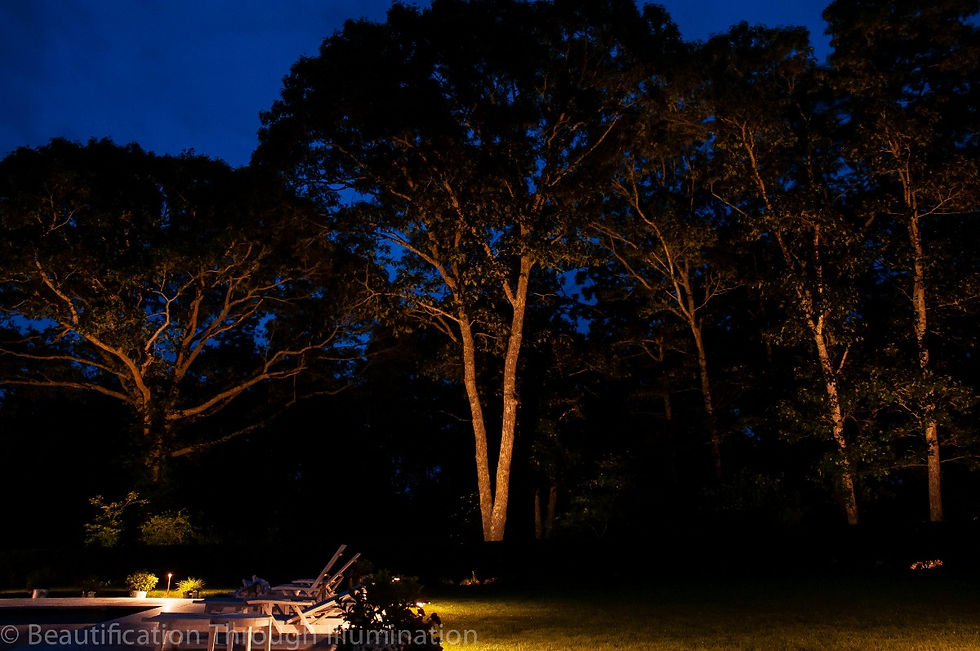
Our whole approach is based on doing less.
We’re not trying to light every inch of a property. We’re not spacing fixtures evenly just because it looks organized on paper. And we’re definitely not cranking everything up to full brightness.
We’re choosing specific things to highlight and leaving everything else alone.
That might mean lighting one tree instead of five, or softly guiding a walkway instead of lining it with lights the entire way. Every fixture has a reason to be there.
If it doesn’t, we don’t add it.
Lighting With Intention
At the end of the day, most of the concerns people have about landscape lighting come from seeing it done poorly.
Too bright. Too much of it. No real thought behind where it goes or why.
And in those cases, the concerns are valid.
But that’s not what landscape lighting is supposed to be.
When it’s done right, it’s subtle. It’s controlled. It respects the space it’s in instead of overwhelming it. It works with the natural environment instead of competing with it.
You still have darkness. You still have balance. You just have a little more clarity in the areas that matter.
That’s really the difference.
It’s not about lighting everything.
It’s about lighting the right things, in the right way.
If you’re curious what this actually looks like on your own property, the best way to understand the difference is to see it in person.
We offer evening demonstrations so you can experience how intentional lighting feels before making any decisions.


Comments